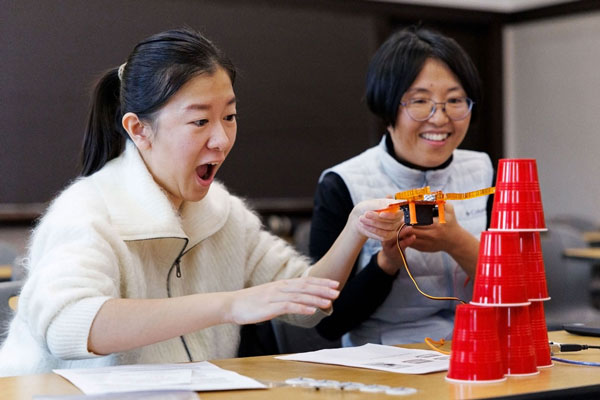
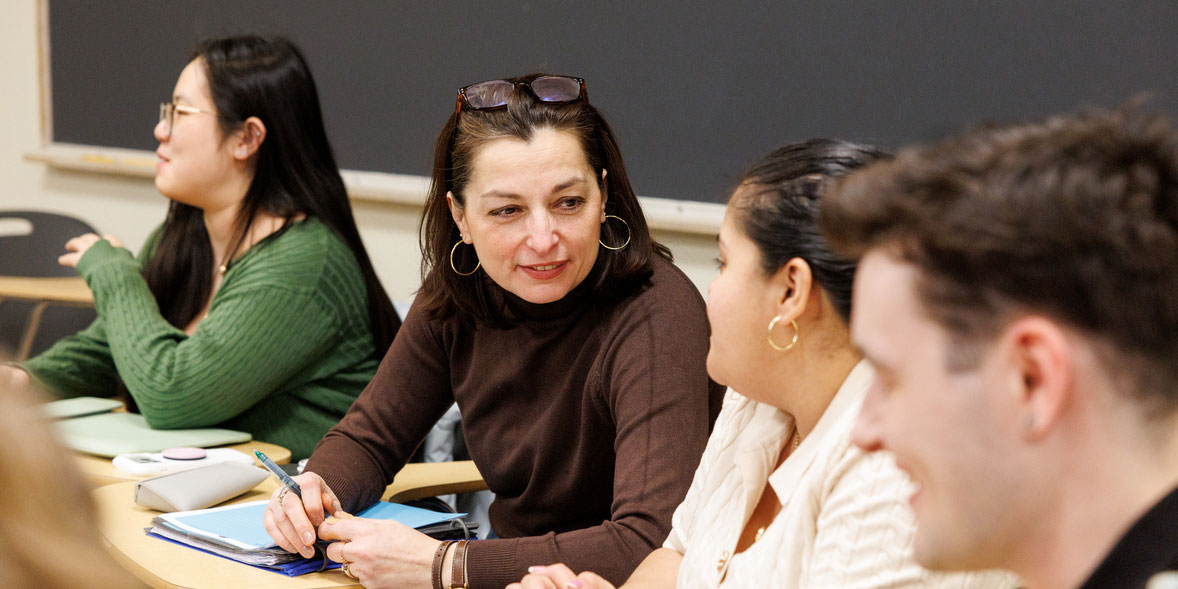
At a Lynch School workshop, participants maneuver a bionic claw via muscle-sensing technology to build a Solo cup pyramid. Photo: Matthew Healey
|
|
|
Using Robotic Hands and High-Tech Glasses, Lynch School Researcher Brings Neuroscience to the Classroom
|
|
|
Neuroscientist Ido Davidesco, an assistant professor at the Lynch School of Education and Human Development, conducts research at the intersection of neuroscience, cognitive science, psychology, and education. But, while most neuroscience is conducted inside laboratories, Davidesco’s scholarship takes place inside science classrooms, where he studies how students pay attention and engage in classroom learning and introduces them to interdisciplinary research.
With a new $1.5 million National Science Foundation (NSF) grant, Davidesco and his research partners are using artificial intelligence (AI) and bionic hands to incorporate neuroscience, engineering design, and computational thinking into high school biology courses.
Another NSF project involves outfitting college students with eye-tracking glasses to collect data that will help the researchers better understand fluctuations in student engagement and attention in the classroom.
|
|
|
“Students are naturally interested in understanding how their own brains work, so ... their interest in neuroscience can be used as leverage to engage them in science more broadly.”
|
Assistant Professor Ido Davidesco
|
Principal Investigator, Lab-to-Classroom Research Group
|
|
|
|
|
|
|
Davidesco recently received a three-year, $1.5 million NSF grant to build upon his neural engineering project. With the new grant, he and his collaborators will revise their tools and curriculum and add an artificial intelligence component.
|
|
|
|
|
By bridging the gap between brain science and the classroom, Davidesco’s Lab-to-Classroom Research Group empowers educators and researchers to work together, turning scientific insights into real-world classroom success.
|
|
|
Answering the call for mental health
|
|
|
Students in the School Counseling master’s program. Photo: Matthew Healey
|
|
|
With the youth mental health crisis intensifying, the Lynch School launched a new M.A. in School Adjustment Counseling in September. Building on the school’s #9-ranked School Counseling foundation, this program pairs academic rigor and 900 hours of hands-on experience to provide holistic support for Pre-K–12 students.
|
|
|
Advancing Science and Educators Worldwide
|
|
|
INCLUSIVE SCIENCE FOR EVERY LEARNER
|
Professor Katherine McNeill and Associate Professor Zhushan Mandy Li are leading a four-year, $2M NSF-funded initiative to boost elementary schools’ science curricula. In partnership with the University of Texas at Austin, the project creates customizable tools designed specifically to help multilingual learners thrive in the classroom. McNeill is a Lynch School Bryk Faculty Fellow.
|
|
THE HUB FOR WHOLE-PERSON LEARNING
|
The recently launched Transformative Education Lab (TLab) is now serving as a national center for formative education. Led by Professor Deoksoon Kim, the TLab is bridging research and practice, providing educators with the resources and conferences needed to foster character and student flourishing nationwide.
|
|
|
Maria Rubiano Quintero, M.A. ’26 (Mental Health Counseling), was awarded the Haberman-Williams MaMHCA Scholarship from the Massachusetts Mental Health Counselors Association last fall.
|
|
Doctoral student Lucy Xie (Counseling Psychology), was named a fellow of the Behavioral Health Integrated Resources for Children (BIRCh) Center.
|
|
|
AERA Conference Reception
|
Boston College reception for alumni, students, faculty, and friends
|
La Lo La Rooftop, AC Hotel
|
Host: Lynch School of Education and Human Development
|
|
Cultivating Hearts & Minds: Formative Education in Catholic Schools
|
Host: Lynch School’s Roche Center for Catholic Education
|
|
|
|